
In petrochemical projects, urban fuel supply systems, and various industrial facilities, the location and type of storage tank are critical decisions. In recent years, more projects have tended to adopt underground storage tanks, primarily to save surface space, improve visual aesthetics, and reduce exposure to external risks. However, an underground storage tank is not simply a tank buried in the ground. It fundamentally changes the structure of risk rather than eliminating it.
This article analyzes the key considerations in selecting underground versus aboveground storage tanks from multiple dimensions, including risk characteristics, application scenarios, technical requirements, and maintenance costs, to help project decision-makers make more scientific and rational choices.
When choosing between underground and aboveground storage tanks, the first step is to understand the essential differences in their risk structures.
For aboveground storage tanks, risks are primarily external and visible. Threats such as vehicle collisions, fire spread, and deliberate attacks are more intuitive. Meanwhile, tank corrosion, weld cracking, and leakage can be easily detected through routine inspection. This “visible and inspectable” nature makes risk management relatively straightforward, allowing problems to be identified and addressed at an early stage.
In contrast, underground storage tanks shift risks to invisible subsurface areas. External surface corrosion progresses continuously in moist soil environments but is difficult to inspect visually. Tank leakage may remain undetected for a long time, only becoming apparent after groundwater or soil contamination occurs. Flotation risks caused by groundwater level changes are particularly dangerous when the tank is empty or at a low liquid level. These risks are characterized by concealment, accumulation over time, delayed detection, and high remediation costs.
Therefore, underground storage tanks are not inherently safer than aboveground tanks. They simply transfer risks from visible external exposure to hidden internal conditions. Without systematic monitoring and maintenance strategies, underground solutions may create greater long-term hazards. Decision-makers must clearly understand that underground installation is not the end of risk—it is a transformation of risk form that requires more sophisticated technical measures and management systems.
After recognizing the structural differences in risk, the next key question is: what technical preparations are required if an underground solution is selected?
An underground storage tank is not merely a buried vessel. It imposes systematic requirements on design, construction, and operation. Four technical dimensions are particularly critical: external corrosion protection systems, anti-flotation design, double-wall structures with leak detection, and chamber design for maintainability.
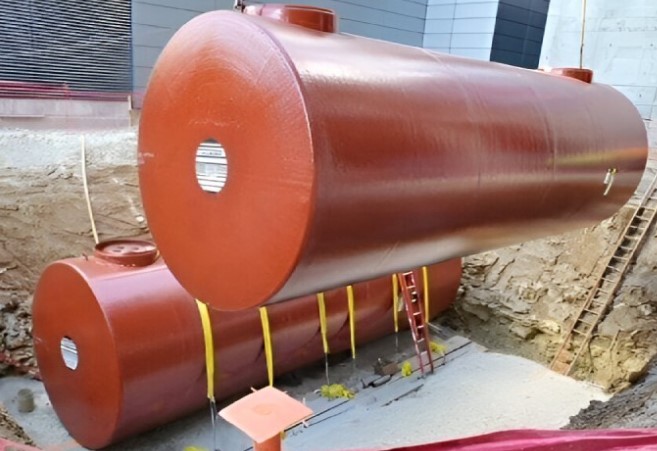
Underground tanks operate long-term in moist, low-oxygen soil environments rich in microorganisms and electrolytes. External corrosion is the primary technical challenge. Unlike atmospheric corrosion, soil corrosion is highly non-uniform, can have rapid localized attack rates, and is difficult to monitor visually.
A reliable corrosion protection system must include multiple defense layers:
Protective coatings or linings form the first barrier. Materials must resist soil stress, cathodic disbondment, and be compatible with cathodic protection systems. Common options include fusion-bonded epoxy, three-layer polyethylene, and coal tar enamel. Selection must consider soil resistivity, pH, and microbial content.
Cathodic protection serves as the second defense line. Through sacrificial anodes or impressed current systems, the tank potential is maintained within a protective range. Proper design requires accurate calculation of protection current demand, rational anode layout, and installation of potential monitoring systems. Cathodic protection must work in combination with coatings; used alone, it is neither economical nor reliable.
Electrical insulation measures are often overlooked but essential. Effective isolation between the tank and connected pipelines, cable conduits, and grounding systems is necessary to prevent stray current corrosion. Insulating joints must also be periodically tested and maintained.
Backfill material and construction quality directly affect coating service life. Fine sand or dedicated backfill soil is recommended. Materials containing gravel or construction debris that may damage coatings must be avoided. Layered compaction should ensure stable support while preventing mechanical damage.
In regions with high groundwater levels or seasonal water accumulation, anti-flotation design is vital. When the tank is empty or at a low liquid level, buoyant forces may exceed the weight of the soil cover, potentially causing uplift, connection rupture, or foundation deformation.
Anti-flotation calculations must consider worst-case conditions: highest groundwater level, empty tank state, and minimum soil cover thickness. Safety factors should account for groundwater uncertainty. Common measures include increasing soil cover, adding concrete ballast slabs, and installing anchor rods or anchor straps.
Equally important is proactive groundwater management. Passive anti-flotation measures alone are often insufficient. A comprehensive drainage system around the tank should include circumferential French drains, collection sumps, pumping systems, and unobstructed drainage channels. Pre-rainy-season inspections, routine pump testing, and backup power supply are indispensable components of anti-flotation management.
For environmentally sensitive media, double-wall underground tanks combined with leak detection systems are standard practice. The interstitial space between inner and outer walls prevents direct soil contamination if the inner tank leaks, providing valuable time for emergency response.
Leak detection should cover the tank body, pipeline connections, and critical valve areas. Common monitoring methods include interstitial liquid level monitoring, pressure or vacuum monitoring, and liquid or gas detection sensors. The system must provide real-time alarms with properly calibrated thresholds to avoid false alarms while ensuring timely detection of actual leaks.
System reliability is equally important. Sensors require periodic calibration. Signal transmission should have redundancy. Power supplies must include backup sources. Historical data show that in many underground tank leakage incidents, monitoring systems were either absent or rendered ineffective due to poor maintenance.
Operation and maintenance of underground tanks heavily depend on surface access chambers. These chambers house valve assemblies, manholes, instrument interfaces, monitoring devices, and maintenance access points. Their design directly affects long-term operability.
Drainage is the first priority. If waterproofing fails or drainage is blocked, water accumulation can accelerate corrosion of valves and instruments, cause freezing damage in winter, and increase flotation risks. Chambers should include sump pits and automatic drainage facilities, with reliable wall waterproofing and regular drainage inspections.
Valve and equipment layout should follow ergonomic principles. Operating heights must be appropriate, handwheels must have sufficient space, and frequently operated valves must be accessible. Equipment replacement feasibility should also be considered: lifting openings for large valves, removable pipe spools, and accessible instrumentation calibration points must be planned during the design stage.
Although underground tanks offer advantages in certain scenarios, aboveground storage tanks remain more economical and reliable for most conventional projects.
The most prominent advantage is ease of maintenance. External surfaces are fully visible, enabling early detection of corrosion, deformation, or leakage. Maintenance does not require confined space entry, reducing risk and improving efficiency. Modifications and capacity expansion are relatively easy. This visible, inspectable, and repairable nature often results in lower life-cycle costs.
In terms of fire safety, aboveground tanks can be equipped with fixed foam systems and spray cooling systems, and fire access routes are easier to design according to standards. Underground tanks rely primarily on soil cover for fire isolation, and once fire breaches the cover layer, firefighting becomes extremely difficult.
Aboveground tanks also offer shorter construction periods and lower initial complexity. They do not require extensive excavation, dewatering, or soil support, and are less affected by geological conditions. For projects with tight schedules or complex subsurface conditions, aboveground solutions are often more feasible.
Furthermore, technical maturity and standards for aboveground tanks are more developed, with extensive engineering experience and comprehensive regulatory frameworks.
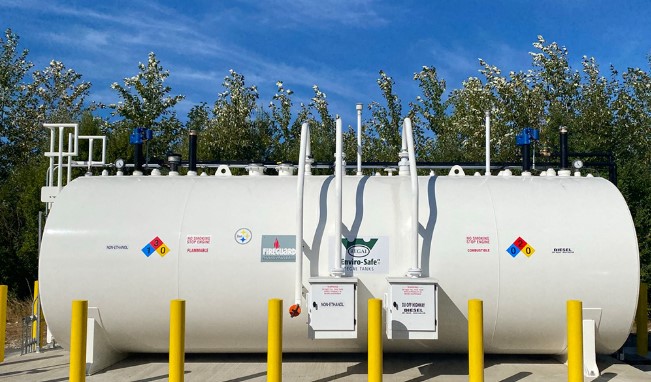
A systematic evaluation process is recommended:
Clarify media characteristics and regulatory requirements. Volatility, toxicity, flammability, and environmental sensitivity are primary considerations.
Assess site conditions and technical feasibility. Groundwater levels, soil corrosivity, and geological stability significantly affect underground solutions.
Analyze life-cycle costs. Compare not only initial investment but also design, construction, operation, maintenance, modification, and decommissioning costs.
Evaluate operation and maintenance capabilities. Underground systems require higher technical competence in cathodic protection management, leak monitoring, and chamber maintenance.
Underground storage tanks are advantageous in:
- Urban centers or visually sensitive areas
- Extremely space-constrained sites
- Locations with high external impact risks
- Applications requiring stable temperature conditions
Aboveground storage tanks are more suitable when:
- Media risks are relatively controllable
- Sufficient space allows compliance with safety distances
- Geological and hydrogeological conditions are complex
- Project schedules are tight
- Long-term maintenance resources are limited
There is no absolute superiority between underground and aboveground storage tanks. The key lies in matching the tank type to project-specific conditions. Underground solutions are not synonymous with being “more advanced” or “safer”; they represent a transformation of risk form that requires more refined technical measures and professional management. Aboveground solutions, while traditional, offer irreplaceable advantages in visibility, inspectability, and maintainability.
The core of decision-making lies in honestly assessing media risks, objectively evaluating site conditions, rationally comparing life-cycle costs, and realistically examining operational capabilities. Avoid blindly choosing underground tanks for aesthetic or space-saving reasons, and avoid rejecting technological progress simply for convenience. Only by integrating technical boundaries, regulatory requirements, economic considerations, and maintainability can a storage tank selection decision withstand the test of time—an approach especially vital in today’s petrochemical industry, where safety, environmental protection, and efficiency are paramount.
