
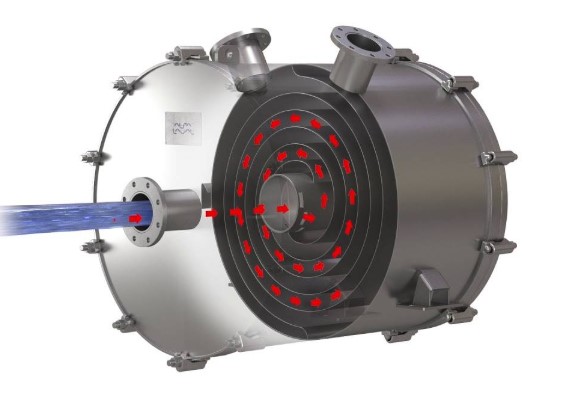
Spiral heat exchangers are uniquely engineered heat transfer devices, composed of two metal plates wound in a spiral formation to create two separate concentric flow channels. This innovative design allows two fluids at different temperatures to exchange heat efficiently without any direct mixing. Structurally, the primary fluid enters through a flange at the front and exits at the top, while the secondary fluid enters from the top and exits at the rear. The spiral configuration of the internal metal plates ensures that the hot and cold fluids remain completely separated throughout their flow paths, maximizing thermal performance while preventing cross-contamination.
In operation, the fluids move in a counterflow arrangement: one fluid enters at the center and flows outward toward the perimeter, while the other fluid enters from the outer edge and flows inward toward the center. This counterflow configuration is a key factor in achieving high heat transfer efficiency and is one of the defining features of spiral heat exchanger performance.
The operation of a spiral heat exchanger is based on fundamental principles of heat transfer and fluid dynamics. Its core design features a single, elongated, curved flow channel with a uniform rectangular cross-section, which produces several notable operational benefits:
- Uniform Fluid Distribution: The spiral channel design ensures that the fluid is evenly distributed across the entire heat transfer surface. This prevents the formation of hotspots or stagnant zones that can reduce thermal efficiency and cause localized fouling or degradation of the fluid.
- Enhanced Turbulence: The continuous curvature of the flow channel induces turbulence in the fluid even at relatively low velocities. Turbulent flow disrupts the boundary layer that naturally forms along surfaces, significantly increasing the convective heat transfer coefficient. In practical applications, spiral heat exchangers can achieve heat transfer coefficients 50–100% higher than conventional shell-and-tube designs under comparable operating conditions.
- True Counterflow Heat Transfer: By allowing the two fluids to flow in opposite directions, spiral heat exchangers establish a strong temperature gradient along the flow path. This maximizes thermal driving force and can even achieve temperature crossovers, where the outlet temperature of the cooled fluid exceeds the inlet temperature of the heating fluid. In cases involving fluids that are prone to gelling, fouling, or freezing, parallel-flow designs may occasionally be adopted to prevent blockages.
- Operational Flow: The primary fluid enters the exchanger, filling the spiral chamber and flowing along the spiral path toward its outlet. Simultaneously, the secondary fluid enters from the top, flowing in the adjacent channel toward its exit. Heat is transferred between the fluids through the metal plate separating the channels, allowing each fluid to reach its target temperature upon exit.
Spiral heat exchangers are widely adopted in industrial applications due to their distinctive structural and operational advantages. These features make them particularly suitable for handling challenging or complex process conditions, often outperforming traditional heat exchanger designs in efficiency, reliability, and versatility.
The spiral design promotes turbulence and reduces thermal resistance, significantly increasing the rate of heat transfer. Compared to conventional shell-and-tube heat exchangers, spiral exchangers can achieve the same thermal duty in a much smaller footprint, which translates directly into energy savings and lower operational costs.
The combination of counterflow and turbulence amplifies the heat transfer effect, ensuring high efficiency even under low-flow conditions, where many conventional heat exchangers struggle. This efficiency makes spiral heat exchangers particularly suitable for energy-intensive processes where maximizing heat recovery is critical.
Spiral heat exchangers occupy considerably less space than conventional designs. The extended flow path is cleverly folded into the spiral, allowing sufficient residence time for heat transfer without requiring a large installation footprint. This compactness is especially advantageous in industrial facilities with space limitations or where retrofitting is necessary.
One of the most prominent features of spiral heat exchangers is their inherent self-cleaning ability. The single continuous flow channel generates a high shear rate along the walls, which helps dislodge deposits and prevent fouling. The continuous spiral geometry ensures that fluids containing suspended solids, fibers, or viscous components do not easily clog the flow path.
This characteristic makes spiral heat exchangers ideal for handling high-concentration slurries, sludge, or fibrous media. In many industrial settings, spiral heat exchangers demonstrate longer maintenance intervals compared to other heat exchanger types, significantly reducing downtime and associated labor costs.
The wide flow channels of spiral heat exchangers enable them to manage viscous fluids and fluids containing solids with relative ease. Fluids such as chemical sludge, wastewater, pulp, or other particle-laden liquids that can clog traditional exchangers can typically flow smoothly through a spiral design.
Materials can be selected to provide resistance to corrosion or chemical attack, and the exchangers are capable of operating under high-temperature and moderate-to-high-pressure conditions. This versatility allows spiral heat exchangers to be applied across diverse industrial environments, from chemical and petrochemical processes to wastewater treatment and food processing.
Spiral heat exchangers typically feature removable covers, providing full access to the internal surfaces for inspection, cleaning, or manual maintenance. Unlike shell-and-tube or plate exchangers, which may require disassembly of entire tube bundles or plates, this design simplifies routine maintenance tasks. While severe fouling may necessitate disassembly, routine cleaning and inspection are relatively straightforward. Over time, the reduced maintenance requirements combined with operational efficiency help offset the higher initial cost of investment.
Spiral heat exchangers’ unique design and performance make them highly versatile and suitable for a wide range of industrial applications:
- Chemical and Petrochemical Industries: Used for heating or cooling chemical process streams, especially with high-viscosity or particle-laden media, such as polymer solutions, reactive slurries, or viscous oils.
- Wastewater Treatment Plants: Ideal for heat recovery from sewage, sludge, or anaerobic digesters. Their self-cleaning ability allows them to handle high solid content fluids without frequent maintenance.
- Power Generation: Used in cooling systems, waste heat recovery, or preheating feedwater to improve overall energy efficiency.
- Food and Beverage Processing: Effective for heating and cooling viscous products such as syrups, jams, or sauces, while maintaining hygiene and thermal efficiency.
- Pulp and Paper Industry: Handles fibrous pulp and paper slurry fluids efficiently, where conventional exchangers often suffer from clogging or fouling.
While spiral heat exchangers offer many advantages, they also have certain limitations that should be considered during selection and design:
- Higher Initial Investment: Due to the complexity of design and manufacturing, spiral heat exchangers are generally more expensive than conventional shell-and-tube or plate exchangers. For smaller installations, this cost difference can be significant.
- Pressure Limitations: While suitable for moderate pressures, their maximum allowable pressure is lower than that of robust shell-and-tube exchangers, limiting their application in extreme high-pressure systems.
- Maintenance for Severe Fouling: Severe fouling may require complete disassembly for cleaning, which can be labor-intensive and time-consuming compared to some online-cleanable designs.
- Limited Design Flexibility: Unlike modular plate exchangers, which can adjust heat transfer capacity by adding or removing plates, spiral exchangers have a fixed heat transfer area once manufactured.
- Constraints with Extremely Viscous or Particle-Laden Fluids: Extremely viscous fluids or those with large solid particles can increase flow resistance and reduce heat transfer efficiency. Although more adaptable than most other designs, spiral heat exchangers still have practical upper limits.
In industrial heat transfer applications, spiral heat exchangers are often compared with shell-and-tube and plate heat exchangers. Key differences include:
- Heat Transfer Efficiency: Spiral and plate exchangers both benefit from turbulence-induced enhancement and typically outperform shell-and-tube exchangers, which may require larger heat transfer areas to achieve similar performance.
- Fouling Resistance: Spiral exchangers’ self-cleaning channels reduce fouling and extend maintenance intervals. Shell-and-tube exchangers experience moderate fouling, while plate exchangers with narrow channels are more prone to clogging.
- Footprint: Spiral and plate exchangers are compact, ideal for limited-space installations, whereas shell-and-tube exchangers require larger footprints.
- Handling Solids and Viscous Fluids: Spiral exchangers excel at handling sludge, slurries, and fibrous fluids, which can easily clog shell-and-tube or plate exchangers.
- Cost: Spiral exchangers are generally higher in purchase cost due to complex manufacturing. Shell-and-tube and plate exchangers are typically more cost-effective upfront.
- Pressure Handling: Shell-and-tube exchangers can tolerate the highest pressures, spiral exchangers are suitable for medium pressures, and plate exchangers have the lowest pressure capacity.
- Flexibility: Plate exchangers offer modular flexibility via plate addition or removal. Spiral exchangers have fixed heat transfer areas after fabrication, while shell-and-tube designs allow some adjustment through tube bundle configuration.
- Maintenance: Spiral exchangers require minimal routine maintenance but can be labor-intensive during severe fouling. Shell-and-tube and plate exchangers need more frequent maintenance, though some designs permit online cleaning.
When selecting a spiral heat exchanger, several factors must be evaluated carefully:
- Fluid Characteristics: Consider viscosity, solid content, chemical composition, and fouling tendency. Spiral heat exchangers are particularly effective for high-viscosity, solid-laden, or fouling-prone fluids.
- Operating Conditions: Evaluate temperature range, pressure rating, and flow rate to ensure the selected materials and construction are suitable.
- Space Constraints: The compact design of spiral exchangers is advantageous where installation space is limited.
- Lifecycle Cost: Assess total cost of ownership, including energy consumption, maintenance, and service life, rather than focusing solely on initial purchase price.
To ensure optimal performance and long service life:
- Regular Inspections: Monitor for fouling, leaks, or wear. Observe temperature and flow changes, as these can indicate efficiency loss.
- Preventive Cleaning: For fouling-prone fluids, establish routine cleaning using compatible cleaning agents.
- Operational Monitoring: Continuously track temperature, pressure, and flow data to detect anomalies promptly.
- Professional Service: Engage experienced personnel for disassembly, cleaning, and thorough inspection when necessary.
Spiral heat exchangers occupy an important role in industrial heat transfer due to their unique spiral design, which combines high thermal efficiency, compactness, self-cleaning capability, and adaptability to challenging fluids. They are particularly suited for conditions with high viscosity, solid content, or fouling potential, where conventional exchangers often underperform.
Although the initial investment may be higher, lower energy consumption and reduced maintenance requirements provide superior long-term economic benefits. Across chemical, environmental, energy, food, and pulp industries, spiral heat exchangers enhance heat recovery, reduce operating costs, and support greener, more efficient production processes.
For engineers and decision-makers selecting heat transfer equipment, understanding the operational principles and performance characteristics of spiral heat exchangers, and aligning them with actual process conditions, is essential to achieving optimal heat transfer efficiency and ensuring stable, reliable industrial operation.
