
Heat exchangers play a critical role in industries that rely on efficient thermal energy transfer. From power plants and chemical processing to HVAC systems and marine engineering, selecting the right heat exchanger design directly affects energy efficiency, maintenance requirements, and overall operating costs. Two of the most common designs are the U-tube heat exchanger and the straight tube heat exchanger. Each heat exchanger offers distinct advantages and limitations depending on the application. This guide provides a comprehensive comparison to help businesses choose the most suitable solution for their needs.
In a U-tube heat exchanger, the tubes are bent into a U shape, allowing fluid to enter from one end, travel through the U-bend, and exit from the same side. The U-bend is not fixed to other internal components, which allows the tube bundle to “float” freely within the heat exchanger. This design eliminates the need for expansion joints, as the tubes can naturally expand and contract with temperature changes.
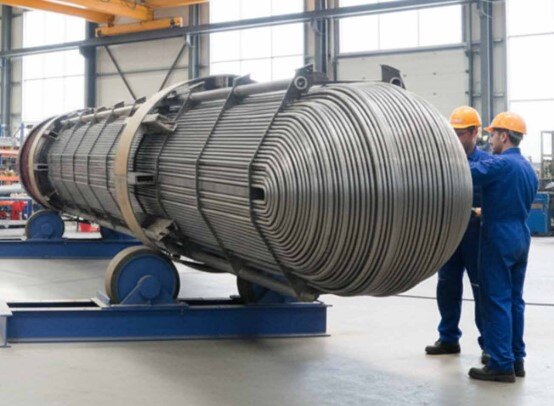
U-tube heat exchangers perform exceptionally well in handling thermal expansion. Because one end is not fixed, the tubes can freely expand and contract, accommodating sudden temperature changes without causing thermal stress damage. This significantly reduces stress caused by temperature fluctuations, making them especially suitable for high-temperature applications such as power plants, refineries, and industrial boilers.
Due to the U-shaped bending, the tubes can flexibly respond to temperature variations without imposing stress on the shell. This flexibility makes U-tube designs ideal for industrial environments with extreme temperature changes or high-pressure operations.
U-tube designs allow longer tube lengths within limited horizontal space, increasing heat transfer area without enlarging the overall exchanger size. Their compact structure reduces footprint, making them suitable for space-constrained installations.
Compared with straight tube heat exchangers, U-tube units contain fewer components, which generally reduces manufacturing and installation costs. They do not require expansion joints or additional stress-relief structures, lowering material and fabrication expenses. Additionally, fewer sealing surfaces improve reliability and minimize leakage risk. The structure is robust, with fewer welded joints, reducing long-term leakage probability.
U-tube heat exchangers present certain maintenance challenges. The curved tubes make internal cleaning difficult, especially in applications prone to fouling. However, a single leaking or damaged tube can be replaced individually without dismantling the entire bundle.
When multiple tubes fail or severe wear occurs, replacing the entire tube bundle can be more economical. As long as the shell is not corroded, cracked, or deformed, the system can be restored simply by replacing the tube bundle, at approximately 40% of the cost of replacing the entire heat exchanger.
Tube bundles can typically be manufactured, transported, and installed faster than full units. In urgent cases, bundles can be produced and delivered within 24 to 48 hours, whereas complete heat exchangers often require 6 to 8 weeks for manufacturing and delivery.
During fabrication, U-tubes require annealing to prevent cracking. Wall thinning at bend areas must be inspected carefully. The bending radius generally follows ASTM A556 standards or customer specifications. The reduced number of connections improves both reliability and manufacturing efficiency.
Unlike U-tube designs, straight tube heat exchangers use a linear tube bundle configuration. While they are less flexible in thermal expansion handling, they offer distinct advantages in cleaning ease, flow performance, and reliability under specific operating conditions.
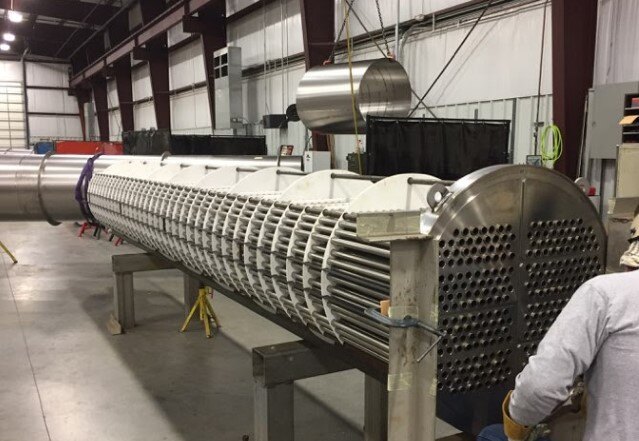
Straight tube heat exchangers consist of tubes arranged in straight lines, connected between two tube sheets. They are the most basic and commonly used tube configuration in heat exchangers. The tubes extend directly from one tube sheet to another without bends or surface modifications.
Typical tube outer diameters range from 6 mm to 88.9 mm, offering a wide variety of size options.
Straight tube heat exchangers come in two main configurations: fixed tube sheet and floating head.
Floating head designs allow thermal expansion, while fixed tube sheet designs require expansion joints to compensate for thermal stress. In fixed tube sheet configurations, both ends of the tube bundle are permanently attached to the tube sheets, which are welded or bolted to the shell.
Floating head designs, similar to U-tube systems, allow one end to move freely while the other remains fixed.
Straight tube designs are easier to clean and maintain, making them suitable for industries requiring frequent servicing such as food processing and pharmaceuticals.
In dirty or fouling-prone conditions, straight tubes reduce blockage risk and are easier to clean mechanically or by flushing. This makes them particularly suitable for high-viscosity fluids or slurry transport.
Because tubes are easily accessible, long-term maintenance efficiency is higher. Individual tubes can be inspected and replaced without dismantling the entire bundle, reducing downtime and maintenance costs.
Straight tube bundles are capable of handling higher flow velocities. The linear flow path reduces turbulence and pressure drop, allowing smoother and faster fluid movement.
They can also be designed with multi-pass or wider flow channels to increase throughput.
Straight tube designs offer strong leakage resistance because only the tube-side fluid contacts gaskets, and tubes typically have fewer sealing joints. Fixed tube sheet designs also benefit from strong structural support, reducing vibration-induced leakage.
Straight tube heat exchangers typically require more installation space and are less suitable for compact industrial environments.
Fixed tube sheet designs without expansion joints are prone to thermal stress, which may cause cracking and leakage.
Although straight tube systems—especially floating head types—have higher initial investment costs, their long-term maintenance costs may be lower.
The U-tube heat exchanger and straight tube heat exchanger differ fundamentally in how they handle thermal stress, maintenance requirements, space utilization, and overall operating behavior. While both serve the same purpose of efficient heat transfer between fluids, their structural philosophies lead to distinct performance characteristics in real industrial environments.
U-tube heat exchangers naturally accommodate thermal expansion because one end is free to move, allowing tubes to expand and contract without stress.
Straight tube exchangers require expansion joints or floating head designs to manage thermal stress. Fixed tube sheet designs without expansion joints are more susceptible to thermal stress-related damage.
U-tube designs are more difficult to clean due to curved tube geometry, which complicates internal access.
Straight tube designs are easier to clean due to their linear arrangement, allowing efficient mechanical cleaning and flushing.
In U-tube systems, individual tubes can be replaced, but replacing multiple damaged tubes may require partial bundle removal.
In straight tube systems, individual tubes can also be replaced; however, in fixed tube sheet designs, full bundle replacement may be necessary in some cases.
U-tube exchangers are compact and require less installation space, making them ideal for tight layouts.
Straight tube exchangers occupy more space and require larger installation areas.
U-tube systems are simpler and generally cheaper upfront. Straight tube systems have higher initial cost but potentially lower long-term maintenance expenses.
U-tube heat exchangers are widely used in high-temperature industries such as power plants and refineries.
They perform better in industrial heat transfer applications due to their superior thermal expansion adaptability. Common applications include commercial HVAC systems, where temperature fluctuations are frequent and space is limited.
They are also used in waste heat recovery steam generators, marine evaporators, and pharmaceutical condensers.
Straight tube exchangers are suitable for industries requiring frequent maintenance, such as food processing and pharmaceuticals.
They are widely used in chemical plants, refineries, paper mills, and food and beverage processing facilities due to their ease of cleaning and ability to handle high flow rates.
They are also commonly found in oil and gas shell-and-tube exchangers, power plant condensers, and sugar mill air heaters.
Selecting between a U-tube heat exchanger and a straight tube heat exchanger is not a matter of which design is universally better, but rather which configuration aligns more effectively with the operating conditions, maintenance strategy, and lifecycle cost expectations of a specific industrial system. Several core factors should be carefully evaluated before making a decision.
U-tube exchangers are suitable for high-temperature applications with compact installation requirements.
Straight tube exchangers are better suited for industries requiring frequent inspection and tube replacement.
U-tube systems are ideal for low-fouling, low-maintenance environments, while straight tube systems are better for high-maintenance or dirty fluid applications.
U-tube designs are compact and suitable for confined spaces.
Straight tube designs require more installation space and are not ideal for compact industrial layouts.
U-tube systems have lower upfront costs due to simpler design. Straight tube systems, especially floating head types, may have higher initial investment but lower lifecycle maintenance costs.
U-tube exchangers use fewer tube sheets, reducing failure risk and extending service life. Their design also allows easier bundle removal, simplifying inspection and cleaning, particularly on the shell side.
Straight tube exchangers benefit from strong structural support, reducing vibration-induced leakage and improving sealing reliability.
The choice between U-tube and straight tube heat exchangers has a significant impact on performance, maintenance, and cost.
U-tube heat exchangers offer high adaptability and versatility, capable of handling various fluids, including corrosive liquids and gases. They are widely used in applications where thermal compensation is critical. Their balanced performance, cost efficiency, and long service life make them essential in industries where reliability directly affects productivity.
Straight tube heat exchangers, on the other hand, are valued for their simple manufacturing process, ease of cleaning and inspection, and wide range of size options. They are more practical in applications requiring frequent maintenance, handling of fouling fluids, or high flow rates.
Ultimately, companies must consider multiple factors when selecting a heat exchanger: operating temperature range, fluid properties, maintenance frequency, available installation space, budget constraints, and long-term operating costs.
There is no absolute superiority between the two designs—only suitability or unsuitability based on specific conditions. By carefully evaluating their requirements, businesses can select the most appropriate heat exchanger design to achieve efficient heat transfer, reduce operating costs, and improve overall production efficiency.
