
In industrial manufacturing and chemical processing, maintaining the purity of fluids and gases is critical. The presence of moisture, vapor, oil droplets, or solid particles in a system can not only compromise product quality but also damage downstream equipment. Coalescing filters are specialized devices designed to remove liquid droplets and vapor particles from fluids and gases. They operate by merging small droplets into larger ones, making contaminants easier to separate and discharge. This article provides a detailed overview of coalescing filters, including their definition, working principles, types, applications, advantages, and guidelines for selection and maintenance.
A coalescing filter is an industrial filtration device used to remove liquid droplets, vapor, and fine particles from gases or liquids. Its primary mechanism is “coalescence,” in which small droplets or bubbles collide and combine to form larger particles. Larger particles are more easily captured by the filter media or allowed to settle under gravity. These filters can achieve extremely high filtration precision, capable of removing particles as small as 0.1 microns or even smaller.
For manufacturers and refineries, ensuring product purity is a fundamental requirement. Contaminants entering a system can reduce product quality—for example, moisture in fuel can impair combustion efficiency. Contaminants can also cause wear, corrosion, or blockages in downstream equipment, increasing maintenance costs and downtime. Coalescing filters effectively prevent these problems by efficiently removing droplets and vapor particles, making them an essential step in protecting equipment and maintaining product purity.
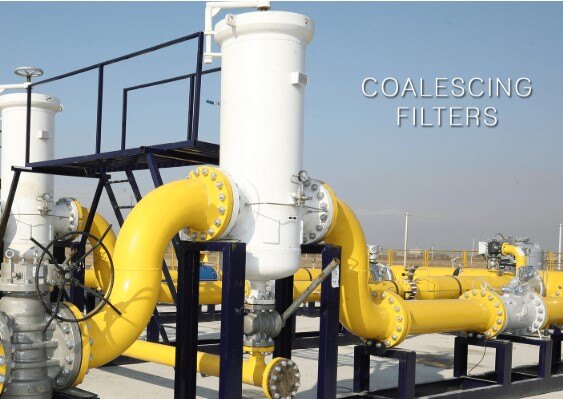
Coalescing filters utilize the natural tendency of droplets to combine. When a fluid containing small droplets—whether gas or liquid—passes through the filter media, droplets collide and merge. As the merged droplets grow in size, they are more easily captured by the filter media. Subsequently, gravity causes the larger droplets to move downward and collect, ultimately being removed from the system. This process is purely physical and does not require chemical additives.
In compressed air systems, for instance, air is often hot, humid, and may contain oil droplets. Coalescing filters redirect airflow, causing oil droplets to collide and merge into larger droplets. The outer layer of filter material captures these droplets, which then flow into a collection bowl under gravity. The collected oil must be regularly drained to prevent recontamination of the system.
Depending on application needs, coalescing filters are primarily categorized into two types:
This is the most common type in industrial applications. It uses baffles, screens, or multi-layered fiber structures to capture moisture and vapor molecules. As the fluid passes through the mechanical structure, droplets are intercepted and combined. Mechanical filters are simple in design, easy to maintain, and suitable for most industrial and chemical processes.
These filters use electric fields to remove droplets, making them suitable for specialized conditions that require handling extremely fine droplets or specific chemicals. Electrostatic filters charge droplets through an electric field, which are then attracted and combined on electrode plates. Although more costly, these filters provide superior performance in high-demand applications.
The core component of a coalescing filter is the filter element. Filter elements are typically made from multi-layered fiber materials, such as borosilicate microfibers or semi-permeable membranes. These materials feature dense, layered structures capable of effectively trapping aerosols and liquid droplets. The small gaps between fibers allow the filter media to capture tiny droplets. As captured droplets accumulate, they move along the fibers and merge, forming larger droplets.
Borosilicate microfibers are common due to their chemical resistance and high filtration efficiency, while semi-permeable membranes are used in applications requiring precise separation. Multi-layer structures ensure that even extremely small particles are intercepted.
The operation of a coalescing filter can be divided into three basic steps:
- Fluid Introduction: Contaminated fluid enters the filter housing and flows toward the filter element.
- Contaminant Capture: Depending on the density and weight of various molecules in the fluid, the filter media adsorbs droplets, vapor, or particles onto the fiber surface. This process relies on interception, inertial impaction, and diffusion mechanisms.
- Droplet Coalescence and Discharge: Small captured droplets move along the fiber surface and merge, forming larger droplets. Once large enough, gravity causes the droplets to detach from the fibers and flow into a collection area. These droplets are then drained from the system or recovered for processing.
Different media exhibit distinct characteristics during filtration. For example, in oil-water separation, heavier oil is directed to the discharge point while lighter water continues to flow through the filter layers. For moisture-laden gases, the filter outputs dry gas after removing water.
- Alternative Fuel Industry: Alternative fuels, including compressed natural gas, propane, and methanol, require coalescing filters during production and use. Filters are applied in gas purification, natural gas dehydration, and high-pressure air storage. Removing moisture and oil droplets improves combustion efficiency and prevents corrosion or blockages in fuel systems.
- Chemical Processing: Cooling water, processing liquids, and gases in chemical plants often contain impurities. Coalescing filters ensure that filtered media meets strict regulatory standards while reducing damage to equipment. In fine chemical production, the purity of reactants is essential for product quality.
- Oil and Gas Industry: Downstream oil and gas production heavily relies on coalescing filters. They are used in crude oil purification, natural gas dehydration, and liquid-gas separation. By removing moisture and solid particles, the final product maintains high purity. Clean fluids also protect downstream equipment such as compressors, pipelines, and valves from corrosion, extending service life.
- Compressed Air Systems: Compressed air often contains significant moisture, oil, and particulates. Prior to reaching pneumatic equipment, the air must be processed through filtration, pressure regulation, and lubrication (FRL units). Coalescing filters are key components in this process.
Industries such as painting, food processing, and paper manufacturing rely on clean compressed air. For instance, oil droplets in compressed air can cause paint defects, while contamination in food processing can compromise product quality. Coalescing filters can remove oil down to 0.01 mg/m³ and particles to 0.01 microns, meeting ISO 8573-1 standards.
- High Contaminant Removal Efficiency: Coalescing filters remove droplets and vapor contaminants with an efficiency of 95–99%. Under optimal conditions, they can remove particles as small as 0.01 microns, ensuring high purity of fluids and gases.
- Protection of Downstream Equipment: Contaminants accelerate wear and corrosion. Oil droplets on pneumatic cylinder components can slow or jam motion, while water causes rusting of pipes and valves. Coalescing filters significantly reduce downstream equipment failures.
- Lower Operating Costs: Reduced equipment failures translate to lower maintenance and replacement costs. Operational efficiency improves, and downtime decreases, collectively reducing overall operating expenses.
- Custom Solutions: For specialized or outdated equipment, standard filters may be inadequate. Custom coalescing filters are designed to match system requirements, extending equipment life, maintaining product purity, and reducing maintenance costs.
- Bowl Material: Collection bowls are commonly made of polycarbonate or metal. Polycarbonate bowls are inexpensive but cannot withstand certain chemicals, high pressures, or extreme temperatures. Metal bowls are suited for harsh environments.
- Oil Discharge Method: Filters may feature manual or automatic oil drainage. Manual systems require periodic inspection and draining, while automatic systems discharge oil when minimum operating pressure reaches 0.35 bar (5 psi).
- Performance Requirements: Filtration precision varies by application. For compressed air systems, filters may need to remove 0.01-micron particles and 0.01 mg/m³ oil. Filters must comply with relevant standards, such as ISO 8573-1.
- Flow Capacity: The filter must handle maximum system flow; exceeding capacity can cause excessive pressure drop or reduced filtration efficiency.
- Maintenance Indicators: Most filters include visual indicators showing filter element status. When replacement is required, the indicator changes from green to red, facilitating timely maintenance.
- Price Considerations: Filter cost depends on materials, flow capacity, maintenance requirements, and application. Filters for air compressors may be more expensive than those for oil or natural gas. High-quality materials and low-maintenance designs may raise initial costs but offer long-term savings.
Regular maintenance ensures optimal performance. Filter elements should be inspected at least annually and replaced immediately if the service indicator turns red. Installing a general-purpose upstream filter to remove larger particles extends the lifespan of the coalescing filter. Proper piping, fittings, and brackets ensure secure installation.
Collected liquids must be regularly drained. For manual drainage, a record system should track maintenance to prevent excessive accumulation and recontamination. For automatic systems, the oil drain valve must be checked periodically.
Coalescing filters are indispensable in modern industrial systems. By merging small droplets into larger ones, they efficiently remove moisture, oil, and fine particles from gases and liquids. Filtration precision can reach 0.1 microns or even 0.01 microns, with efficiency exceeding 95%.
Various types of coalescing filters exist: mechanical filters suit most industrial scenarios, while electrostatic filters are used for specialized conditions. Multi-layered fiber structures within the filter carry out three main steps: fluid introduction, contaminant capture, and coalescence and discharge.
Coalescing filters are widely applied in alternative fuels, chemical processing, oil and gas, and compressed air systems. Advantages include high contaminant removal efficiency, protection of downstream equipment, lower operating costs, and customizable solutions. Selection should consider bowl material, drainage method, performance, flow capacity, and maintenance indicators. Regular maintenance and timely filter replacement ensure long-term, stable operation. By using coalescing filters correctly, industrial enterprises can enhance product purity, reduce equipment failures, extend equipment lifespan, and lower overall operational costs.
