
In early oil and gas production facilities, three-phase separators are indispensable pieces of equipment for handling wellhead production. Their main function is to efficiently separate the mixed phases of oil, gas, and water, delivering single-phase fluids suitable for subsequent processing steps. Despite being considered standard equipment in industry specifications, the performance of three-phase separators in actual field operations often deviates from design expectations. Operational challenges such as unstable liquid levels, liquid carryover, foaming, and scaling in downstream equipment are frequently not the result of operator error but rather the consequence of insufficient consideration of real-world conditions during the design stage. Notably, two separators with similar pressure ratings and nominal capacities may exhibit markedly different behavior in practice, particularly during the initial months of commissioning. This underscores the importance of a comprehensive understanding of production conditions beyond standard design parameters when selecting a three-phase separator.
- Limitations in Interpreting Production Data: One of the primary challenges during the design phase arises from the interpretation of production data. Early production curves are inherently unstable, with flow rates, gas-oil ratios (GOR), and water cuts often fluctuating beyond initial projections. Designs based solely on a single operating point fail to account for these variations, which can leave separators with minimal operational margin under changing conditions. From an engineering perspective, a separator’s performance across a range of production scenarios is typically more important than its peak capacity. Therefore, effective selection requires consideration of production fluctuations rather than focusing exclusively on design-point efficiency.
- Overlooked Impact of Downstream Equipment: Separation efficiency should never be assessed in isolation. Downstream requirements play a critical role in determining acceptable phase purity. In some installations, minor water carryover in the oil phase may not immediately pose issues; however, when heaters, pumps, or dehydration units follow the separator, even slight contamination can accelerate wear or cause operational instability. Downstream sensitivity directly informs design decisions, including retention time, inlet arrangement, baffle design, and liquid-level control strategy. Increasing vessel volume alone does not guarantee improved performance; excessively large separators at low flow rates can complicate liquid-level control, creating operational difficulties.
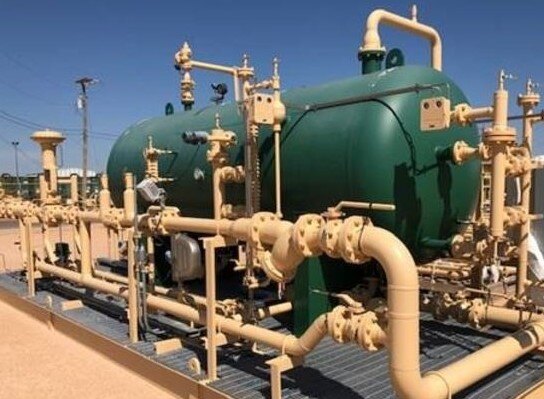
A core parameter in separator design is the gas-liquid ratio (GLR), which is often underestimated in its influence on vessel performance. GLR fundamentally determines the separator’s physical dimensions, flow path configuration, and phase separation efficiency.
GLR refers to the volumetric ratio of gas to liquid under specific flow conditions. High gas fractions increase flow velocity within the separator, making liquid droplets more susceptible to being carried over by the gas phase. In such cases, the separator must provide sufficient residence time and separation space for droplets to settle. Conversely, when the liquid fraction dominates, gas handling is less critical, but the liquid phase requires adequate retention time to ensure complete separation, necessitating a larger liquid-holding volume.
Neglecting GLR in design can lead to gas carryunder (liquid being carried into downstream gas systems) or liquid carryover (gas entering the liquid collection zone). Both scenarios can severely impact compressors, pumps, and other downstream processing equipment, potentially causing operational disruptions, mechanical wear, or even equipment failure.
Pressure and temperature directly influence GLR and separator sizing. High operating pressure increases gas density, which affects diameter calculations and phase separation efficiency. Elevated temperature reduces gas density, potentially requiring a larger vessel to achieve the same level of separation. Additionally, fluid properties such as viscosity significantly affect droplet settling rates; high-viscosity liquids may require increased retention space even when GLR is appropriately accounted for.
A typical workflow for separator design includes the following steps:
- Gas-phase sizing: Determine the gas section diameter based on stable gas flow, correcting for pressure, temperature, and fluid viscosity.
- Liquid-phase sizing: Calculate the volume required to achieve adequate retention time for the liquid phase.
- Design margin: Choose the larger of the two values as the design basis and add a 10–20% safety margin to accommodate production fluctuations.
Even with the same GLR, fluids from different reservoirs can behave differently in operation. Hence, vessel sizing should integrate field data, fluid characteristics, and operational variability rather than relying solely on formulaic calculations.
The choice between horizontal and vertical separators is not determined purely by theoretical separation efficiency but by operational context, site limitations, and flexibility requirements.
Horizontal separators: These are ideal for handling higher liquid volumes and processes requiring longer oil-water retention times. Their broad interface provides tolerance for fluctuating water cuts, making them more forgiving in early production operations. Horizontal separators are often chosen for operational flexibility rather than compactness.
Vertical separators: Best suited for gas-dominated production or space-constrained installations. However, vertical separators are more sensitive to fluctuations in liquid load, requiring careful interface control and monitoring during initial operation.
Field constraints such as limited space, cold climates, remote locations, and maintenance accessibility strongly influence the selection of separator orientation, nozzle placement, and internal baffle configuration. These considerations require balancing practical layout requirements with idealized process design, as purely mechanical calculations cannot address all operational challenges.
Importance of Inlet Design: While gravity separation is the fundamental principle, actual separator performance depends heavily on internal flow behavior. Many separation issues stem from excessive inlet momentum, uneven flow distribution, or insufficient liquid residence time. Even if theoretical calculations are satisfied, poor inlet design can result in carryover or instability. Minor differences in inlet design or flow distribution can significantly affect long-term separation stability.
Value of Customization: In practice, modest customization of standard separators often yields better performance. Standard designs offer predictable cost and delivery schedules but may not suit fields with variable production, high solids content, or site constraints. Custom-designed separators tailored to field behavior enhance operational stability, improve equipment longevity, and reduce maintenance needs.
Impact of Sand Production: Solids, particularly sand, are frequently underestimated in separator selection. Early production wells or unconsolidated formations can produce significant sand, which can accumulate inside the vessel, reduce effective volume, interfere with instrumentation, and necessitate frequent shutdowns for cleaning. Without proactive design, these factors compromise long-term separator performance.
Preventive Measures: Even moderate sand production can cause internal corrosion, obstruct instruments, and reduce effective separation volume over time. For fields with expected sand production, installing a cyclonic desander upstream of the separator ensures solids removal prior to entering the vessel, protecting internal components and maintaining stable operation.
Effective three-phase separation depends on robust liquid-level and interface control. Operational experience shows that overall control philosophy is more important than the specific choice of instrumentation. Systems with narrow control margins may respond poorly to production fluctuations, resulting in frequent alarms or manual interventions.
Simple, tolerant control systems often provide better stability, especially during early production or well-testing operations when conditions are constantly changing. Three-phase separators must simultaneously control both gas-liquid and oil-water interfaces:
Poor gas-liquid interface control allows gas into the liquid phase or liquid into the gas phase.
Poor oil-water interface control degrades oil quality and separation efficiency.
Control system responsiveness and accuracy should align with the characteristics of production variability to maintain stable operation.
Responding to Production Variability: Separator selection is rarely a straightforward sizing exercise. While engineering calculations are necessary, many operational issues arise from changes in production conditions after commissioning. Gas flow may fluctuate, water cut can increase earlier than expected, and solids may appear after well clean-up. These factors often explain why a separator that appears adequate during design reviews may underperform in real-world operation.
Two-Phase vs. Three-Phase Selection: For wells with low, predictable water production, two-phase separators may suffice. However, as water cut rises or becomes variable, independent oil-water control becomes essential. Three-phase separators are widely used in early production facilities, extended well testing, and marginal fields where reservoir behavior is uncertain. They ensure operational flexibility and minimize the need for continuous manual intervention.
Three-phase separators should be considered integral components of the production system rather than isolated pressure vessels. When design fully accounts for field conditions, downstream requirements, solids behavior, and operational constraints, separators can operate reliably and efficiently.
Key factors for successful separator selection include:
- Gas-liquid ratio: Determines essential separation space.
- Pressure and temperature: Affect fluid density and vessel sizing.
- Fluid properties: Viscosity and density influence settling behavior.
- Downstream sensitivity: Guides separation precision and control strategy.
- Solids management: Ensures long-term stability.
- Field conditions: Space, climate, and maintenance accessibility.
- Control philosophy: Simple, robust systems outperform complex precision systems.
- Early manufacturer involvement: Minimizes risk of post-design modifications.
In oil and gas processing, separator sizing requires balancing performance, cost, and operational stability. By adopting a systematic selection approach that integrates field data, operational experience, and fluid characteristics, engineers can choose separators that meet current needs while remaining adaptable to future production changes. This ensures safe, efficient, and sustainable operation across the facility lifecycle.
