
Hydrostatic testing of storage tanks, often referred to in the industry simply as a water test, is a mandatory and critical verification procedure conducted after tank fabrication and installation are completed. In simple terms, the process involves filling the tank with water and applying a specified pressure to verify its sealing performance, structural strength, and operational safety.
The core objectives of hydrostatic testing can be understood at three levels. First is safety: filling the tank with water displaces oxygen inside the vessel, preventing the formation of explosive mixtures between oxygen and residual vapors, thereby eliminating potential fire or explosion hazards at the source. Second is quality assurance: the test verifies weld integrity, material performance, and the overall structural reliability of the tank. Third is functional validation: it confirms the tank’s load-bearing capacity and long-term operational stability under actual service conditions.
It is important to clarify that many projects mistakenly interpret hydrostatic testing as merely filling the tank to see if it leaks. This understanding is incomplete. In engineering practice, hydrostatic testing serves not only for leak detection, but also for structural verification, settlement observation, weld quality confirmation, and final acceptance inspection. Particularly for large-diameter, heavy-duty storage tanks, hydrostatic testing is often one of the highest-load and highest-risk phases of the entire project.
The preparatory work before hydrostatic testing is the foundation for ensuring smooth test execution. Adequate preparation can help avoid unexpected situations during testing and improve overall efficiency.
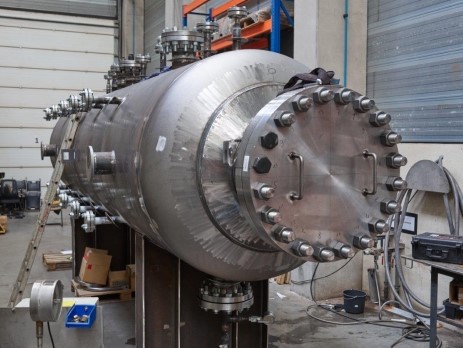
Before conducting hydrostatic testing, a comprehensive inspection of the tank body must be carried out. This includes confirming whether all welding operations have been completed, whether key weld seams have undergone non-destructive testing in accordance with design requirements (such as radiographic testing or ultrasonic testing), and whether all accessories and connecting nozzles have been installed in place. Temporary blind plates and sealing plugs must also be installed reliably.
It is especially important to note that pressure testing must be completed before formal hydrostatic testing. The purpose of pressure testing is to ensure that the internal pressure of the container does not exceed the designed working pressure of the vessel. During pressure testing, pressure gauges and other instrumentation systems must be checked regularly to ensure measurement accuracy and prevent equipment failure.
The stability of the storage tank foundation is directly related to testing safety. It is necessary to confirm whether the foundation strength meets design requirements, whether the ground conditions are stable, and whether drainage ditches and water collection points are properly arranged. If the testing period coincides with the rainy season or low-temperature weather, the potential influence of climatic conditions on the testing process must also be evaluated.
Liquid level observation points, settlement monitoring points, and measuring rulers or other measuring instruments must be prepared in advance. At the same time, recording forms for the testing process and responsible personnel assignments must be clearly defined to ensure that each step is supervised by designated personnel and can be traced through documentation.
These two items are often the most easily underestimated preparation tasks. The following questions must be considered in advance: Where will the water come from? How long will it take to fill the tank? Where will the water be discharged after testing? Will the drainage flow erode the foundation or construction site?
If these issues are not planned in advance, it is very likely that the project schedule will become uncontrollable or secondary risks may occur during field operation.
In regions with strict environmental protection requirements, it is also necessary to consider whether drainage treatment such as sedimentation is required, whether the water contains oil stains or other pollutants, and avoid causing environmental contamination during the testing process.
Warning signs must be set up around the hydrostatic testing area. Risks of slipping and drowning must be evaluated and controlled. Emergency pumping equipment and proper lighting facilities must be prepared. Professional personnel should conduct on-site guidance and supervision, and inspect the working condition of relevant equipment as well as environmental safety.
After completing the above preparation work, the formal hydrostatic testing stage can begin. The quality of preparation work directly determines whether the testing process will proceed smoothly. A clear testing plan, confirmed conditions, and well-implemented safety measures can help reduce unexpected incidents during field operation. Conversely, insufficient preparation may lead to schedule delays, data loss, or even safety accidents.
First, the inlet and outlet openings of the storage tank must be tightly sealed to ensure that no liquid leakage or gas leakage occurs during the testing process. Sealing operations must be reliable because any negligence may lead to test failure or safety accidents.
Engineering practice strongly recommends adopting staged water filling rather than rapid one-time filling. For large-diameter storage tanks, staged filling offers several significant advantages:
Allows gradual settlement of the foundation, making it easier to observe settlement trends and structural conditions
Enables early detection of bottom plate leakage or local abnormalities and prevents problems from becoming more serious under higher water levels
Reduces sudden risk occurrence and provides sufficient time and space for troubleshooting
A common practice is to gradually increase the water level by predetermined stages. When each stage height is reached, observation and recording should be carried out for a short period before continuing filling.
At each filling stage, the following conditions must be carefully observed and recorded:
Tank shell condition: whether there are abnormal deformation, bulging, or indentation
Tank bottom condition: whether seepage occurs, especially at bottom plate lap joints and corner welds
Connections and manholes: whether leakage occurs
Foundation surroundings: whether erosion or cracking appears
Settlement data: readings of settlement monitoring points
When the water level reaches the required test height, pressurization should be carried out according to relevant standards. The pressurization process must be performed slowly while closely monitoring pressure changes inside the tank. After reaching the test pressure, pressure must be maintained for a certain period of time to observe whether the pressure remains stable and whether any abnormal structural changes occur in the tank body.
After the test is completed, pressure must be released gradually, and the system pressure release process must be monitored. The pressure release speed must not be too fast to avoid structural impact caused by sudden pressure changes.
Common Failures and Handling Methods During Hydrostatic Testing
Liquid Leakage: If liquid leakage is detected, water filling must be stopped immediately and the cause of leakage must be identified. Common causes include weld defects, aging sealing components, and loose flange connections. After troubleshooting, the test must be repeated to ensure testing accuracy. Once leakage is found, water filling must not continue; otherwise, seepage may spread, the foundation may be damaged, or the problem may become more serious.
Gas Leakage: Gas leakage usually occurs at poorly sealed locations. All sealing points and connection joints must be inspected. If necessary, sealing materials should be replaced or fastening operations should be repeated.
Abnormal Foundation Settlement: If uneven settlement or excessive differential settlement is found during testing, the test must be suspended immediately, and the foundation bearing capacity and foundation design must be evaluated. Severe settlement problems may require foundation reinforcement treatment.
Instrument Failure: Pressure gauges, liquid level gauges, and other instrumentation devices may malfunction during testing. Therefore, backup instruments should be prepared, and instrument accuracy should be calibrated regularly.
Low-temperature flushing measures should be adopted when hydrostatic testing is conducted in cold environments to prevent water inside the tank from freezing and expanding in volume, which may damage the storage tank structure.
Anti-static measures should also be taken. Friction between water flow and the tank wall may generate static electricity. Therefore, grounding measures and water flow velocity control should be implemented to prevent static sparks from triggering accidents.
Personnel safety protection must be ensured. Necessary safety protection equipment must be provided at the test site, including life-saving equipment, anti-slip facilities, and emergency lighting systems. All participating personnel must receive safety training and understand emergency response plans.
Environmental protection measures should also be considered during hydrostatic testing. Water discharge should be controlled to prevent environmental pollution, including regulating discharge water quality, preventing soil erosion, and properly treating wastewater generated during testing.
Leakage at Bottom Plate and Corner Welds: Such problems are often associated with welding quality, bottom plate lap joints, foundation unevenness, or local stress concentration. The key is to detect problems early and carry out repairs promptly to prevent problem expansion.
Foundation and Ground Settlement Risks: Full water loading will cause actual settlement to occur. If uneven settlement or excessive differential settlement occurs, secondary stress may be generated on the tank bottom and tank wall. In severe cases, structural deformation or damage may occur. Therefore, settlement observation must be carried out throughout the entire hydrostatic testing process. After the tank is fully filled and stabilized for a period of time, settlement monitoring should continue to confirm that the settlement trend remains stable.
Drainage Risks: When the drainage volume is large and the drainage speed is too fast, foundation erosion may occur, site flooding may be caused, or surrounding roads and equipment may be affected. Therefore, drainage pathways, flow rate control, and environmental compliance requirements must be planned in advance, and the drainage process must be supervised by dedicated personnel.
The integrity of process records must be ensured. Testing records must be complete, including filling time, water level height, pressure data, observation results, and handling of abnormal situations. These records serve as important acceptance evidence.
Structural integrity must be confirmed. The storage tank must show no abnormal deformation or continuous leakage. Inspection of key parts must meet qualification requirements. Any detected defects must have corresponding repair records and re-inspection documentation.
Settlement data must be qualified. Settlement observation data must fall within allowable limits and show a stable trend.
Cleaning and restoration work must be completed after testing. Drainage, cleaning, and site restoration must be carried out to ensure that there are no obvious residues or contaminants inside the tank that may affect subsequent use. For storage tanks that are sensitive to cleanliness requirements of stored media, further drying or purging treatment may be required after hydrostatic testing to avoid corrosion or medium contamination caused by residual moisture.
For pressure equipment, pneumatic tightness testing and system linkage inspections may also be required after hydrostatic testing to ensure that the delivered equipment meets operational conditions.
Storage tank hydrostatic testing is a critical stage that verifies engineering quality under real load conditions. It is not a simple procedural step but a true engineering validation process that safeguards project delivery.
Proper planning, staged water filling, synchronized settlement observation, controlled drainage risk management, and strict alignment with recording and acceptance standards are necessary to ensure the long-term safety and reliability of storage tanks.
For manufacturing enterprises, clearly communicating hydrostatic testing requirements at the early stage of project coordination can significantly reduce on-site disputes and delivery fluctuations while improving project management quality and customer satisfaction.
For operating organizations, understanding the importance and key control points of hydrostatic testing helps strengthen supervision of the testing process and ensures the long-term safe operation of storage tanks after commissioning.
Whether for design institutes, manufacturers, or end users, hydrostatic testing of storage tanks should be treated with the highest level of attention. Testing must be carried out strictly in accordance with technical standards and specifications, with safety always placed as the top priority, so that hydrostatic testing can fully perform its intended function and lay a solid foundation for the safe operation of storage tanks.
