
Finned tube heat exchangers are essential devices for achieving efficient heat transfer in industrial applications. They are widely used across HVAC systems, power generation, chemical processing, refrigeration, and automotive manufacturing. The key design principle lies in attaching metal fins to the exterior of base tubes, significantly increasing the heat transfer surface area. This design not only dramatically improves thermal efficiency but also maintains a compact equipment structure. By doing so, it reduces energy consumption and operating costs while enabling the heat exchanger to perform reliably under high temperature, high pressure, and corrosive conditions.
Finned tube heat exchangers come in various types, including extruded fin tubes, L-shaped fin tubes, embedded fin tubes, welded fin tubes, and spirally wound fin tubes. Among these, H-type fin tubes are particularly popular in boiler economizers and other waste heat recovery systems due to their high mechanical strength, low flue gas resistance, and excellent soot-blowing performance. Selecting the appropriate finned tube heat exchanger requires careful consideration of heat transfer requirements, material compatibility, fin design parameters, operating conditions, and cost-effectiveness, ensuring long-term, stable, and efficient system performance.
A finned tube heat exchanger is an industrial device designed to transfer heat between two fluids without direct contact. Typically, a metal wall separates the fluids. Unlike conventional smooth-tube heat exchangers, finned tube heat exchangers feature additional metal fins attached to the tube's exterior, increasing the surface area for heat exchange and enhancing overall thermal efficiency.
Fins are usually made from highly conductive materials such as aluminum or copper. These fins are bonded to the tube surface, allowing the heat from the fluid inside the tube to be efficiently transferred to the fluid or air outside. By adding fins, the heat exchanger achieves high performance while maintaining a compact overall size.
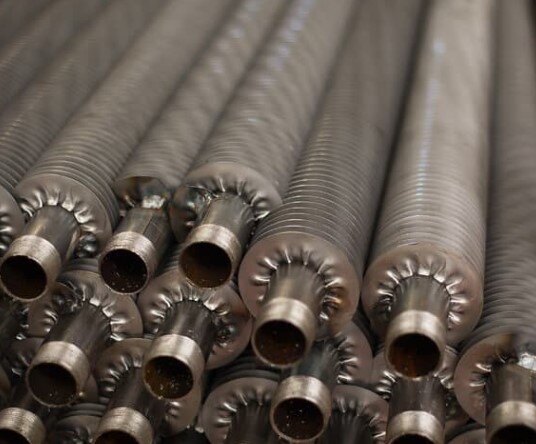
The operation of a finned tube heat exchanger relies on two fundamental physical processes: conduction and convection. As the hot fluid flows inside the tube, heat is first conducted through the tube wall to the outer surface. The fins attached to the tube further transfer the heat to their surfaces, expanding the area over which heat can dissipate. Cooling fluid flowing around the fins removes heat via convection, completing the heat exchange process.
The addition of fins significantly improves overall heat transfer efficiency. For the same tube diameter and length, a finned tube offers much greater surface area than a smooth tube, enabling faster and more efficient energy exchange. This makes finned tube heat exchangers a common choice in industrial heating and cooling processes.
By leveraging the combined effects of conduction and convection, finned tube heat exchangers outperform conventional smooth-tube designs in several critical ways. These advantages can be summarized across four dimensions: efficiency, space utilization, cost savings, and environmental adaptability.
Fins dramatically increase the heat transfer surface area, allowing the system to reach target temperatures more quickly. The expanded contact area between the hot fluid inside the tube and the cooling fluid outside enhances the rate of heat transfer. This feature makes finned tube heat exchangers particularly effective in applications requiring rapid response and precise temperature control.
Finned tube heat exchangers can achieve high heat transfer capacity in a limited space. Compared with traditional smooth-tube exchangers, achieving the same thermal performance requires less equipment volume. This compact design makes them ideal for space-constrained environments, such as HVAC systems inside modern buildings or industrial equipment with limited structural space.
High-efficiency heat transfer reduces the runtime and load of fans and compressors, lowering energy consumption. Improved efficiency directly translates into lower operating costs. Although some high-quality finned tube exchangers may have higher upfront costs, their superior performance and durability reduce overall operational costs over the long term.
Finned tube heat exchangers function effectively in both high- and low-temperature environments. By selecting appropriate materials and structural designs, they can handle corrosive fluids, high-pressure conditions, and extreme temperatures. Stainless steel finned tubes perform well in harsh environments, aluminum fins offer lightweight corrosion resistance, and copper fins excel in applications requiring high thermal conductivity.
Different manufacturing methods give finned tubes distinct performance characteristics suitable for diverse industrial scenarios. The most common types are described below.
Extruded fin tubes are made by pressing aluminum fins onto the base tube, creating a strong bond and excellent thermal contact. Their high mechanical strength and stable long-term performance make them ideal for industrial applications requiring high heat transfer efficiency and durability.
L-shaped fin tubes feature fins wrapped around the tube in an L configuration. This design ensures solid thermal contact while reducing the risk of fin detachment. L-shaped fin tubes are suitable for applications requiring high heat transfer rates while maintaining reliability.
Embedded fin tubes have fins recessed into the tube surface, maximizing heat transfer efficiency and durability. This construction ensures stable performance even under high-temperature conditions, making them ideal for industrial environments with significant thermal stress.
Welded fin tubes attach fins to the tube via welding, providing excellent mechanical stability. They can withstand high-pressure environments, making them suitable for power plants and industrial boiler systems where strength and reliability are critical.
Spirally wound fin tubes are produced by wrapping fin strips around the base tube. This method is relatively simple and cost-effective. However, the bond strength is lower than that of extruded fins, resulting in slightly reduced heat transfer efficiency. Spirally wound fin tubes are suitable for applications where cost is a primary concern and operating conditions are not overly demanding.
With the wide variety of finned tube types and specifications available, engineers must consider several factors to select the most suitable heat exchanger for a specific process. Five key considerations are highlighted below.
The first step is to determine the exact heat transfer requirements of the application. Consider the temperature difference between the two fluids, flow rates, and required heat exchange capacity. For high-demand applications, tubes with larger surface areas and higher thermal conductivity should be chosen. Copper fin tubes, for example, are ideal where rapid heat transfer is needed due to their excellent thermal conductivity.
Selecting tube and fin materials depends on fluid compatibility and operating environment. In corrosive conditions, stainless steel or aluminum fin tubes are commonly used. Aluminum fins are lightweight and corrosion-resistant, suitable for a wide range of applications. Copper fins provide excellent heat transfer and antibacterial properties, making them ideal for hygienic applications. Stainless steel fins offer durability and corrosion resistance, suitable for harsh industrial conditions.
Fin design, including shape, height, spacing, and thickness, directly affects heat transfer efficiency and pressure drop. Higher fin density increases heat transfer but may raise fluid pressure loss. Continuous fins suit high-efficiency applications, while serrated fins perform better at low flow rates. Fin spacing should balance thermal performance and pressure drop according to specific process needs.
Temperature, pressure, and fluid velocity significantly influence finned tube selection. High temperatures and pressures can cause thermal expansion or contraction, creating mechanical stress or tube damage. Materials with high melting points and thermal stability should be used in high-temperature applications. Copper tubes, for example, maintain stable performance at elevated temperatures. Equipment should also allow for easy maintenance to prevent dust or debris accumulation, which reduces efficiency.
Cost is an important factor in engineering decisions. Prices vary depending on materials, dimensions, and manufacturing methods. Selection should consider long-term costs, including maintenance, replacement cycles, and energy consumption. While high-quality finned tube exchangers may have higher upfront costs, their superior durability and performance reduce total operational costs over the equipment’s lifespan.
Finned tube heat exchangers have become indispensable across many industries due to their efficiency and adaptability. Some typical application areas include:
In HVAC systems, finned tube heat exchangers are used in air conditioning and heating units. Their compact structure makes them suitable for installation in limited building spaces. Efficient heat transfer helps maintain stable indoor temperatures while reducing fan energy consumption.
In power plants, they are used in cooling towers and condensers. Finned tube heat exchangers recover waste heat from flue gases, improving energy utilization and reducing fuel consumption. H-type fin economizers are a typical example, capturing exhaust heat to achieve energy savings.
Chemical production often requires precise temperature control. Finned tube heat exchangers, made from corrosion-resistant materials like stainless steel, ensure long-term stable operation even when handling aggressive chemicals.
In industrial and commercial refrigeration, finned tube heat exchangers maintain low-temperature environments. Their high heat transfer capability allows refrigeration systems to quickly achieve and sustain desired temperatures, suitable for industrial freezers, cold storage, and commercial refrigeration facilities.
In automotive applications, they are used for radiators and oil coolers. Radiators dissipate engine heat into the air, while oil coolers maintain lubricant temperature using finned tube structures, ensuring optimal engine performance.
- Regular Cleaning: Over time, fins and tubes may accumulate dust or debris, reducing heat transfer efficiency. Regular cleaning is essential to maintain performance. Care must be taken to avoid damaging fin structures, which could compromise thermal efficiency.
- Corrosion Checks: For heat exchangers operating in corrosive environments, regular inspections for corrosion are necessary. If corrosion is detected, damaged components should be replaced or protective coatings reapplied to extend equipment life.
- Pressure Drop Monitoring: Monitoring the pressure drop across the heat exchanger is an important indicator of operational status. Excessive pressure drop may indicate blockages or declining efficiency, requiring maintenance. Regular monitoring allows early detection of issues, preventing operational disruptions.
Finned tube heat exchangers occupy a crucial role in industrial heat transfer due to their increased surface area, compact design, and diverse material options. From extruded fin tubes to H-type economizers, different types serve distinct operational needs. Selecting the right heat exchanger requires considering heat transfer requirements, fluid characteristics, operating conditions, and cost factors to ensure optimal performance. With proper selection, installation, and maintenance, finned tube heat exchangers can sustain high-efficiency heat transfer over many years, providing reliable support for energy conservation in industrial production.
