
In many engineering projects, storage tank insulation is often simplified as wrapping with insulation and covering it with metal sheets. This one-sided understanding obscures the complex and critical nature of insulation systems. Insulation systems are by no means merely a matter of stacking material thickness; their success depends more on the rationality of the structure, waterproof performance, and subsequent maintenance management. Poor insulation can have consequences far more severe than a slight temperature drop. Once the insulation layer is penetrated by water, it can lead to corrosion under insulation (CUI). If the external protective layer on storage tank becomes loose, wind and rain can penetrate, causing long-term dampness. Winter freeze protection can fail, leading to frozen pipelines and valves, and there may even be safety hazards such as the external protective layer falling off. For engineering projects, the insulation system is a combined project of temperature control + structural protection + lifecycle management, which must be designed and delivered from a system-level perspective.
Storage tank insulation serves many important purposes, which determine different insulation strategies. First, reducing heat loss and maintaining medium temperature stability is the key requirement for high-temperature storage tank insulation. In high-temperature environments, heat loss not only wastes energy but can also cause fluctuations in the temperature of the medium inside the tank, affecting the stability of the production process and product quality.
Second, preventing low-temperature media from absorbing heat and causing frost or condensation is also an important task for insulation. When the medium inside the storage tank is below the dew point temperature of the surrounding environment, water vapor in the air will condense on the tank surface as water droplets or frost. This not only reduces insulation effectiveness but can also lead to corrosion issues.
Winter freeze protection and preventing medium viscosity increase or crystallization are the main goals of low-temperature storage tank insulation. In cold winters, if the medium inside the storage tank freezes, it will cause pipeline blockages, affect normal production processes, and may even lead to safety accidents.
In addition, reducing breathing losses and operational fluctuations caused by temperature differences is also an important function of storage tank insulation. When the medium inside the storage tank undergoes temperature changes, it generates a breathing effect, leading to medium evaporation losses and unstable operating conditions. Reasonable insulation measures can effectively reduce such losses and fluctuations.
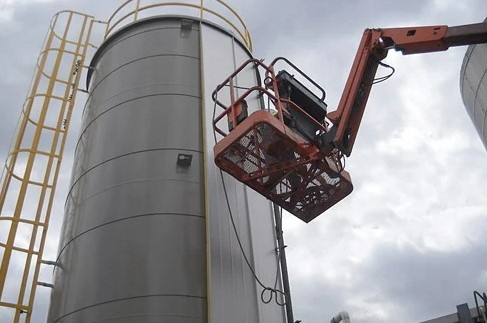
The selection of insulation materials is the first step in storage tank insulation but by no means the only consideration. Common insulation materials in engineering include rock wool, glass wool, polyurethane, and polystyrene boards, each with advantages and disadvantages suitable for different operating conditions.
Rock wool has good thermal insulation and fire resistance, but its water absorption rate is high. Once water penetrates, insulation performance declines rapidly and it forms a long-term damp environment, directly increasing the risk of CUI. Glass wool has good thermal insulation and is convenient for construction, but also suffers from high water absorption. Polyurethane foam has excellent insulation performance, high compressive strength, and good waterproofing, but its temperature resistance level is relatively low, and thermal aging must be considered. Polystyrene boards have good insulation, moderate cost, and easy construction, but relatively poor fire resistance and durability.
For large-area structures like storage tanks, the water absorption and durability of materials are very critical. When selecting insulation materials, one must comprehensively consider the tank's operating conditions, surrounding environment, and maintenance capability, rather than relying solely on price or past experience. For high-temperature tanks, attention should be paid to material temperature tolerance and thermal aging performance to ensure long-term stable operation in high-temperature environments. For low-temperature tanks or tanks with high condensation risk, attention should be paid to moisture resistance and vapor barrier capability to prevent water penetration from reducing insulation performance and causing corrosion issues.
What truly determines the lifespan of an insulation system is often its construction and waterproofing performance. The external protective layer (such as a metal cladding) is not only a “sun and rain shield” but also bears important sealing and drainage responsibilities. The overlap direction, overlap width, rivet or screw layout, edge sealing, treatment of penetration points (platform supports, ladders, nozzles, instrument ports, etc.), and rainproof construction of the tank top and bottom are all key factors in determining whether the insulation layer will be penetrated by water. Many CUI cases start with water entering through a small gap in the external protective layer, flowing along the insulation layer, stagnating at low points or interface roots, causing long-term corrosion that is difficult to detect.
For outdoor storage tanks, the construction principle must adhere to “prevent water ingress + allow drainage”: avoid water entry wherever possible, and if water enters, ensure it has a path to drain out rather than being trapped in the insulation layer.
When designing the external protective layer, all possible water ingress paths must be fully considered, and corresponding waterproof measures taken. For example, the overlap direction of the external layer should align with the water flow direction, the overlap width must be sufficient to prevent rainwater from seeping in through gaps, rivet or screw spacing must be reasonable to ensure sealing, and penetration points such as platform supports, ladders, nozzles, and instrument ports must be sealed to prevent rainwater infiltration. The tank top and bottom must be designed with proper drainage slopes and channels to prevent rainwater accumulation on the insulation layer.
Insulation and external corrosion protection are closely bound. Once the insulation layer is applied, inspecting the external tank wall becomes more difficult, so the corrosion protection level of the tank wall usually needs to be higher, with reinforcement at key locations. Welds, interface roots, supports, and platform connection points are both coating weak points and high-risk points for water ingress.
A common practice in engineering is to apply high-quality corrosion protection on the external wall before insulation installation, reinforce key areas with additional layers, and seal penetration points and edges.
Simply put, insulation does not “protect the steel plate”; on the contrary, water ingress can accelerate corrosion. Therefore, the external corrosion protection quality must be ensured. If the external protection is insufficient, water penetration into the insulation layer will accelerate tank wall corrosion, shortening the tank's service life. In storage tank insulation design and construction, external corrosion protection requirements must be fully considered to ensure the coordination between the insulation layer and corrosion protection layer.
Heat tracing is a key aspect of many freeze protection projects. Insulation alone cannot guarantee that the medium will not freeze under extreme low temperatures, especially for pipelines, valves, and nozzle areas. The choice between steam tracing, electric tracing, or hot water tracing should be based on medium temperature requirements, on-site energy conditions, operational management capability, and safety requirements.
Heat tracing layout, temperature control method, insulation coverage, and maintenance accessibility must be considered during the design stage. Otherwise, issues often arise in the field, such as “heating available but difficult to maintain,” “unstable temperature control,” or “local overheating.”
When selecting a heat tracing method, all factors must be fully considered. Steam tracing is suitable for sites with steam supply but requires consideration of steam pressure stability and insulation of tracing pipes. Electric tracing is convenient to install, reliable, and flexible in control, but requires consideration of power supply and cable selection. Hot water tracing requires consideration of hot water supply and circulation system design. Regardless of the chosen method, the heat tracing system must coordinate with the insulation system to achieve optimal freeze protection.
Maintenance and inspection are the final safeguards for the long-term reliability of insulation systems. Insulation systems are not permanently reliable after installation. Loosening of the external protective layer, aging of sealant, penetration cracks, and damage from heavy rain or strong winds can all cause gradual system failure.
A more stable engineering approach is to clearly define inspection points and intervals at handover, such as focusing on tank top edges, nozzle penetration points, external layer overlaps, and low-point drainage areas. Water ingress should be addressed promptly when detected. For high-risk CUI areas, periodic sampling or non-destructive testing (NDT) can be used to detect problems early rather than waiting for perforation.
Regular inspection and maintenance can promptly detect insulation system issues and take corrective measures to ensure long-term stability. Inspection points include the integrity of the external layer, aging of sealant, thickness and uniformity of the insulation layer, and the functionality of drainage channels. Identified problems should be addressed promptly, such as replacing aged sealant, repairing damaged external layers, and clearing drainage channels. High-risk CUI areas should undergo periodic sampling or NDT to detect potential corrosion early and take remedial measures to prevent further expansion.
Storage tank and pipeline insulation commonly uses rock wool, aluminum silicate, glass wool, polyurethane, and polystyrene boards. These materials have good thermal insulation, moderate cost, and are easy to construct, making them common insulation materials today.
- External Insulation: Insulation materials are tightly applied to the external surface of tanks or pipelines and covered with protective materials such as galvanized steel sheets, aluminum-zinc alloy sheets, or stainless steel sheets. These provide corrosion and mold resistance and aesthetic appeal, suitable for higher-standard projects.
- Internal Insulation: Insulation materials are installed inside the tank or pipeline and covered with protective materials such as FRP lining or internal coatings. Advantages include ease of construction and saving on materials and labor, suitable for smaller tanks or pipelines.
- Sandwich Panel Insulation: Insulation material is sandwiched between two thin steel sheets to form a layered structure. This provides thermal insulation while minimizing external environmental impact, suitable for specialized tanks and pipelines.
During construction, attention must be paid to insulation thickness and uniformity, ensuring there are no defects or gaps. Thickness should be calculated based on tank operating conditions and insulation requirements to achieve the design effect. Insulation must be evenly applied, avoiding local thickness variations that affect performance. After insulation, sealing must be performed to prevent heat and moisture loss. Regular inspection and maintenance ensure long-term stable operation of tanks and pipelines.
Storage tank insulation is a highly specialized task requiring professional teams. Professional teams not only have rich construction experience and technical capabilities but also strictly follow design requirements and construction standards to ensure the quality and performance of insulation systems.
When selecting a construction team, factors such as qualifications, reputation, construction experience, and quality assurance systems should be fully considered, choosing a reputable and experienced team.
Professional teams conduct detailed inspections and assessments of the storage tanks before construction, formulate reasonable construction plans based on tank operating conditions and insulation requirements, strictly follow these plans during construction, and conduct thorough inspection and acceptance after completion to ensure the insulation system meets design and quality standards. Therefore, choosing a professional construction team is crucial to ensure the quality and performance of the storage tank insulation system.
Storage tank insulation is by no means a simple “material thickness project”; it is a complex construction and waterproofing project. Only by linking objectives, materials, construction, corrosion protection, heat tracing, and maintenance into a system can temperature control be achieved, CUI risk reduced, and long-term stable operation ensured. For manufacturing and delivery teams, clarifying insulation details in the early stage often significantly reduces complaints and rework after commissioning.
During storage tank insulation design and construction, all factors must be fully considered and addressed at the system level to ensure the quality and performance of the insulation system. Only in this way can storage tanks operate stably under all conditions, providing strong support for project safety and efficiency.
