
In the field of water treatment, multimedia filters are widely used, and their filtration performance directly determines water quality. Air–water backwashing technology is a core process that ensures the long-term, efficient operation of multimedia filters. This article provides an in-depth discussion of the principles, advantages, operating procedures, and precautions of air–water backwashing for multimedia filters, helping readers gain a comprehensive understanding of this highly effective cleaning technology.
A multimedia filter is filled with filter media of different particle sizes and materials, commonly including quartz sand, anthracite, and activated carbon. These media are arranged in layers according to a specific sequence to form an efficient filtration system. When water enters the filter, larger suspended particles are first intercepted by the coarser upper media. As the water continues to percolate downward, smaller impurities are gradually captured by the finer media in the middle and lower layers.
For example, quartz sand removes most silt and other larger particles; anthracite further adsorbs colloids and some organic matter; and activated carbon, with its rich pore structure, adsorbs dissolved organic compounds and residual chlorine. Through this layered filtration mechanism, multimedia filters effectively reduce turbidity, suspended solids, and organic content, providing high-quality influent for subsequent water treatment processes.
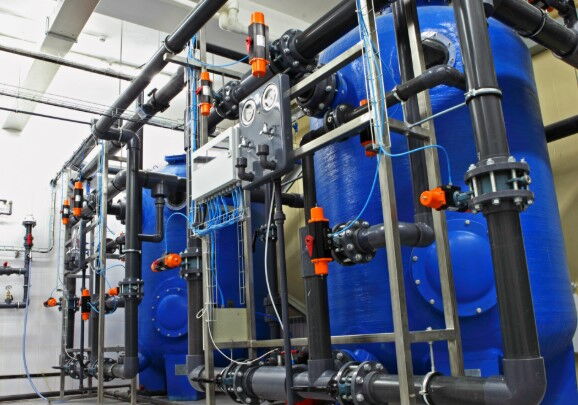
During long-term operation, various contaminants, such as suspended solids, colloids, and organic matter, gradually accumulate on the surface of the filter media. These contaminants not only reduce the dirt-holding capacity of the media but may also cause media agglomeration or cementation, severely impairing filtration performance.
Traditional single water backwashing can remove some contaminants, but it has drawbacks, including high water consumption, incomplete cleaning (especially of deep media layers), and a shortened filtration cycle after backwashing. As a result, air–water backwashing technology was developed. By combining air agitation with water flushing, this method more thoroughly detaches contaminants from the media surface and restores filtration performance.
The core of air–water backwashing lies in the complementarity of “air agitation” and “water flushing.” Compressed air passes through the filter media in the form of bubbles, generating intense shear forces and collisions that loosen and detach contaminants adhered to the media surface, breaking up compaction and caking that can occur during water-only backwashing. Subsequent water flow rapidly carries the loosened contaminants out of the filter, preventing reattachment to the media surface.
Through this synergistic effect, air–water backwashing can significantly reduce backwash water consumption, typically by 30%–50%, while extending the filtration cycle by 20%–30%.
After backwashing, the media surface is clean with no obvious contaminant adhesion. The effluent turbidity is ≤1 NTU, and SDI is ≤5 (≤3 in pure water pretreatment applications). The dirt-holding capacity is restored to more than 90% of that of new media, demonstrating that air–water backwashing effectively restores filtration performance and ensures high water quality standards.
Backwash water consumption is controlled at 3%–5% of the produced water volume (compared with 6%–8% for traditional water backwashing), while air consumption is controlled at 0.3–0.5 m³/m² (based on media bed area). The total backwashing duration is ≤25 minutes. This efficient cleaning method saves significant water resources and reduces energy consumption, offering notable economic and environmental benefits.
During backwashing, media loss is ≤0.1%, with no layer mixing or collapse, ensuring uniform flow distribution during filtration and preventing localized short-circuiting. This indicates that air–water backwashing not only provides effective cleaning but also protects the filter media, extends media service life, and reduces equipment maintenance costs.
After understanding the advantages of air–water backwashing, it is essential to master the correct operating procedures. Proper execution ensures efficient filter operation and maximizes equipment service life. The detailed procedures are as follows:
Before backwashing, confirm that the backwash water pump and air compressor are operating normally and that pressure gauges and flow meters are accurate. Check that the filter vent valve, drain valve, and backwash valve operate smoothly without leakage. Record the inlet–outlet pressure differential, influent turbidity, and effluent turbidity before backwashing to determine whether backwashing conditions are met. Ensure that the backwash drainage pipeline is unobstructed to prevent backflow. Wear insulated gloves and safety goggles, and verify that the air compressor pressure is stable at 0.6–0.8 MPa (air receiver pressure).
- Close Inlet and Outlet Valves: Close the filter inlet and outlet valves, open the vent valve, and release internal pressure (reduce to below 0.02 MPa) to avoid pressure shock to the media bed during backwashing. Open the drain valve to discharge surface污 water inside the filter (approximately water equivalent to 10% of the media bed height), reducing contaminant concentration during backwashing.
- Air Scouring Stage: Start the air compressor and slowly open the air valve. Adjust the air scouring intensity to the set value (controlled by a flow meter), ensuring uniform expansion of the media bed without localized collapse. Observe the discharge at the drain outlet; a large amount of suspended solids and foam will be discharged initially. If media loss is observed, immediately reduce air scouring intensity. After the set air scouring time is reached, close the air valve and stop air scouring.
- Combined Air–Water Backwashing Stage: Start the backwash water pump and slowly open the backwash water valve, adjusting the water flushing intensity to the set value. Simultaneously start the air compressor and open the air valve to maintain air scouring intensity. Observe changes in the discharge water quality, which should gradually change from dark and turbid to clear and transparent. Record discharge turbidity (measure every 2 minutes). When discharge turbidity reaches ≤5 NTU, the combined backwashing stage may be terminated early. If the set time is reached but the water remains turbid, extend backwashing by 2–3 minutes.
- Water-Only Backwashing Stage: Close the air valve and stop air scouring while maintaining the same water flushing intensity. Continue flushing: keep a higher water flushing intensity (upper limit of the set value) for the first 3–5 minutes, then gradually reduce it to the lower limit over the next 5 minutes to stabilize the media bed. When discharge turbidity is ≤3 NTU with no visible suspended solids, shut down the backwash water pump and close the backwash water valve to stop water flushing.
- Restore Filtration Operation: Close the drain valve, open the vent valve, and slowly open the inlet valve to fill the filter, removing residual air from the media bed to prevent air binding during filtration. When water overflows from the vent valve, close the vent valve and open the outlet valve to resume filtration. Record the inlet–outlet pressure differential and effluent turbidity after backwashing to verify effectiveness (pressure differential should drop to 0.02–0.03 MPa, and effluent turbidity should be ≤1 NTU).
- Pressure Control: During backwashing, internal filter pressure must not exceed 0.1 MPa to prevent excessive media expansion and layer disturbance. Air compressor pressure must not exceed 0.8 MPa to prevent air pipe rupture.
- Flow Adjustment: Backwash water flow and air flow should be adjusted gradually to avoid sudden increases that may cause media loss.
- Environmental Protection: Backwash wastewater must be routed to a wastewater treatment system and must not be discharged directly to avoid environmental pollution.
- Equipment Fault Handling: If equipment failure occurs during backwashing (e.g., pump trip or air compressor shutdown), immediately close relevant valves, release filter pressure, and troubleshoot. Backwashing must not be resumed until the fault is eliminated.
Air–water combined backwashing is an efficient cleaning method used when media contamination is severe or when fine-grained media are applied. Its core principle lies in the synergistic action of air agitation and water flushing to more thoroughly detach contaminants retained on the media surface, such as suspended solids, colloids, and biofilms, and discharge them from the filter, thereby restoring filtration performance.
In the air scouring stage, compressed air (typically at 0.1–0.15 MPa) is introduced into the media bed. Large numbers of bubbles form within the media pores, creating intense agitation, collision, and shear forces as they rise. These forces impact contaminants on the media surface, breaking inter-particle adhesion forces (such as van der Waals forces and electrostatic attraction) and causing retained particles to detach. Bubble agitation also induces friction and collision among media particles, further enhancing contaminant removal, particularly for fine particles embedded in media voids.
After air scouring (or during combined air–water washing), backwash water is introduced to generate upward hydraulic flow within the media bed. On one hand, the water carries the contaminants loosened by air scouring, now in suspension, out of the filter through the drain outlet. On the other hand, water flow further loosens the media bed, preventing re-agglomeration after air scouring and rinsing residual fine contaminants from the media surface.
The combination of air scouring and water flushing is not a simple addition but a coordinated solution to the limitations of single-method cleaning. Water-only backwashing relies solely on hydraulic scouring, which may be insufficient to remove tightly adhered contaminants in deep media layers or fine pores, especially when media particle size is small and porosity is low. Air scouring penetrates deep into media voids to first loosen contaminants, which are then efficiently removed by water flow.
Using air scouring alone may detach contaminants but lacks sufficient water flow to discharge them, allowing redeposition. Using water alone requires higher flow rates and longer durations, leading to water waste. In combined air–water backwashing, air scouring “loosens” contaminants while water flushing carries them away, achieving superior cleaning at lower water flow rates and reduced energy consumption.
After long-term operation, contaminants may bond media particles together, forming localized cementation (e.g., biofilm encapsulation). Intense air agitation breaks these cemented structures and restores media looseness, while water flushing completely removes the broken fragments, preventing performance degradation.
For example, when treating high-turbidity or organic-rich raw water, sticky contaminant layers (such as algae or biofilms) easily form on media surfaces. Air bubbles penetrate these layers and break them apart through collision and shear. During combined washing, water flow further disperses the fragments into suspension, and in the final water flushing stage, these suspended contaminants are fully removed, ensuring a clean media surface.
Air–water backwashing technology for multimedia filters is an efficient, energy-saving, and environmentally friendly cleaning method. Through the synergistic action of air agitation and water flushing, it significantly improves media cleaning effectiveness and restores filtration performance. In practical operation, strict adherence to operating procedures and precautions ensures smooth backwashing, extends media service life, and reduces equipment maintenance costs. With the continuous advancement of water treatment technologies, air–water backwashing will find wider application across more fields, making an important contribution to water quality improvement and environmental protection.
