
In the field of water treatment, multimedia filters are widely used to remove suspended solids and impurities from water by means of different types of filter media, thereby achieving effective water purification. However, during long-term operation, filter media loss is a frequent problem that negatively affects filtration efficiency, increases operating costs, and disrupts the normal operation of downstream equipment. This article provides an in-depth analysis of the causes of filter media loss and proposes practical, targeted solutions to help industry professionals effectively address this challenge.
Although filter media loss may appear to be a minor issue, its consequences can be significant and far-reaching.
First, it directly reduces filtration efficiency. Filter media are the core functional components of a filter. Once media are lost, the pore structure of the filter bed changes, allowing particles that were previously retained to pass through with the water flow, resulting in deteriorated effluent quality.
Second, filter media loss increases operating costs. On one hand, lost media must be replenished regularly, raising procurement expenses. On the other hand, frequent media replacement and equipment maintenance consume additional labor, materials, and time.
More seriously, escaped filter media may enter downstream units such as pumps, valves, reverse osmosis membranes, and ion exchange resins, causing blockage or mechanical damage. This not only impairs the performance of downstream equipment but may also lead to more severe water quality problems or even system-wide failure, resulting in substantial economic losses.
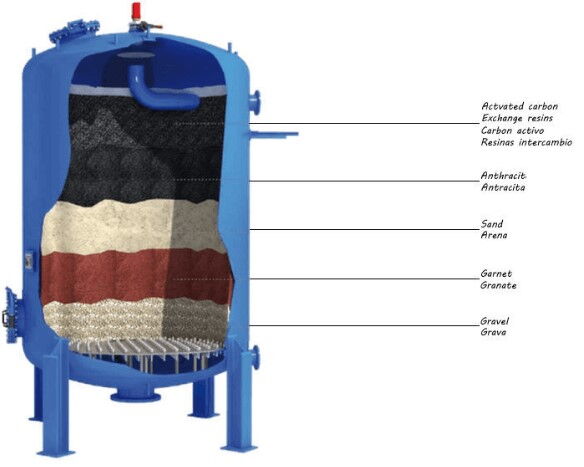
Although filter media loss may seem trivial, it is usually the result of multiple interacting factors. To solve the problem effectively, its root causes must be thoroughly understood. The following analysis examines filter media loss from the perspectives of media properties, equipment structure, operating parameters, and maintenance management.
The physical properties of the filter media themselves are among the most critical factors influencing media loss. Common media such as quartz sand, anthracite, and ceramic media are subjected to continuous hydraulic scouring and friction during backwashing. If the media have insufficient compressive or abrasion resistance, they are prone to breakage and pulverization, generating fine particles. These fines are easily carried away by the water during filtration or backwashing, particularly during backwash operations where hydraulic disturbance is much stronger.
Media gradation, i.e., particle size distribution, also directly affects the pore structure of the filter bed. If the gradation is too fine or the particle size transition between different media layers is improper, such as when the minimum particle size of anthracite is smaller than the maximum particle size of quartz sand, the internal pore structure becomes unstable. In such cases, smaller particles are easily entrained by the water flow and lost. In addition, excessive impurities mixed into the media, such as fine sand or debris left over from installation, can also be washed out during normal operation or backwashing.
Filter nozzles (or underdrains) are key components that support the filter media and ensure uniform water and air distribution. If the nozzle material ages, cracks, or if the slot or pore size exceeds the minimum particle size of the media, filter media may pass directly through the openings into the underdrain system. Uneven installation or poor sealing of the filter plate, as well as gaps between the filter plate and the vessel shell, can also allow media to leak into the collection zone.
Loose or detached nozzles, insufficient nozzle quantity, or uneven distribution can cause locally high flow velocities that force media through the filter plate. Similarly, inlet distributors such as perforated pipes or baffles may create localized high-velocity zones if their openings are uneven, clogged, or damaged, forming “scouring channels” that carry media out of the filter bed.
Backwash air and water distribution systems, such as perforated pipes or diaphragm-type air diffusers, can also contribute to media loss if distribution is uneven. Excessive backwash intensity in localized areas may cause excessive bed expansion or even violent agitation, leading to media being washed out.
Aging seals at the filter cover or flange connections, loose bolts, or cracks in the vessel shell can also result in media leakage. During backwashing, pressure fluctuations inside the filter further increase the risk of leakage.
Backwashing is essential for restoring filter performance, but improper backwash control is the most common cause of filter media loss. If the backwash water velocity or air scour intensity exceeds the critical fluidization threshold of the media, the filter bed may expand excessively, causing intense particle collisions and allowing media to be carried out with the backwash water. Low-density media such as anthracite are particularly susceptible to loss under excessive backwash intensity.
Excessive backwash duration is another contributing factor. Once effective cleaning has been achieved, continued hydraulic disturbance may re-suspend stabilized media, increasing the likelihood of loss and disrupting bed stratification, which can lead to media migration during subsequent filtration.
If air scour flow rates are too high during air-only backwash, or if air–water combined backwash intensities are excessive, strong hydraulic impacts can damage the filter bed structure and cause media loss. During normal filtration, excessively high filtration rates, beyond design limits, can also cause problems. For example, quartz sand filters are typically designed for 8–12 m/h; operating above 15 m/h significantly increases shear forces on the media, allowing fine particles to migrate through the bed and exit with the effluent. Sudden flow rate fluctuations can also generate hydraulic shocks that destabilize the filter bed.
Inadequate maintenance is another major cause of filter media loss. If filters are not periodically opened and inspected, gradual media wear and breakage may go unnoticed, reducing bed depth over time. Issues such as channeling or uneven flow distribution may worsen if not corrected promptly, further accelerating media loss.
Aging, clogged, or loose filter nozzles that are not replaced in time may develop enlarged openings, allowing continuous media leakage. Corrosion or deformation of the filter plate can compromise structural support, permitting media to enter the underdrain system.
When media loss due to normal wear is not promptly compensated with media of the same specification and gradation, increased bed porosity makes further media loss more likely. Adding replacement media with significantly different particle sizes or densities can also disrupt bed stratification and trigger additional losses.
Although filter media loss is a complex issue, it is not unsolvable. By addressing media selection, equipment design, operating parameters, and maintenance practices, effective solutions can be implemented to ensure stable filter operation and improved system performance.
Filter media should be selected based on raw water quality and design requirements, with sufficient compressive strength and abrasion resistance. For example, quartz sand should have a Mohs hardness of ≥7, while anthracite should have a compressive strength of ≥95%. Media quality certificates should be reviewed to confirm particle size, density, and uniformity coefficient compliance. Typical particle sizes are 0.5–1.2 mm for quartz sand and 1.2–2.0 mm for anthracite.
Media loading should follow the principle of “coarser and lighter on top, finer and denser at the bottom,” ensuring proper particle size transitions between layers and avoiding intermixing. The uniformity coefficient (K80) should generally be controlled between 1.6 and 2.0 to minimize fines and reduce loss risk.
Filter nozzles should be made of corrosion-resistant materials with slot or pore sizes smaller than half the minimum media particle size. High-strength ABS, PP, or stainless steel nozzles are preferred. Before installation, the flatness of the filter plate should be checked (tolerance ≤2 mm/m), and double sealing using sealant and bolts should be applied to eliminate gaps. Each nozzle should be individually inspected after installation, and hydraulic testing should be conducted before media loading.
Inlet distributors should be cleaned regularly to remove blockages. If opening distribution is uneven, redrilling or replacement is required to ensure uniform flow. Backwash air and water distribution systems should also be inspected and repaired regularly to ensure even coverage without dead zones or high-impact areas.
Seals at the filter cover, flanges, and vessel welds should be inspected periodically. Aging gaskets must be replaced, loose bolts tightened, and any shell cracks repaired with epoxy or by replacing damaged sections.
Backwash intensity should be determined through testing based on media density and particle size. Typical backwash intensities are 15–20 L/(m²·s) for quartz sand and 10–15 L/(m²·s) for anthracite. Bed expansion rates should be controlled at 50–80% for quartz sand and 30–50% for anthracite to ensure effective cleaning without over-expansion.
Backwash duration should generally be 5–10 minutes for water-only washing, or 3–5 minutes of air scour followed by 5–8 minutes of combined air–water washing. Backwashing should end when effluent turbidity is ≤10 NTU. A recommended sequence is low-intensity air scour, followed by combined air–water backwash, and finally water-only rinsing.
Filtration rates should be maintained within design limits (e.g., 8–12 m/h). Flow stability can be achieved using control valves or variable-frequency pumps. Where raw water flow fluctuates significantly, an upstream equalization tank can help buffer hydraulic shocks.
Filters should be opened for inspection every 3–6 months to check bed height, uniformity, and media integrity. If channeling or uneven flow is observed, media should be removed and reloaded evenly. When media loss exceeds 10%, replenishment with media of identical specification and gradation is required to restore design bed depth.
Filter nozzles and plates should be dismantled and inspected every 1–2 years. Aging, cracked, or loose nozzles must be replaced, and filter plate corrosion or deformation addressed promptly.
Operational records, including backwash parameters, media replenishment volumes, and maintenance activities, should be maintained and analyzed to identify loss patterns and optimize operating strategies. For example, during high water temperature seasons, slightly reduced backwash intensity may be necessary due to decreased media density.
If sudden media loss is detected, such as a sharp increase in effluent turbidity or excessive media in backwash discharge, immediate action is required. The filter should be taken out of service, inlet and outlet valves closed, and internal water drained. The nozzles, filter plate, and distribution systems should be inspected to locate and repair the leakage point. Lost media should be replenished, the bed leveled, and a hydraulic test performed before returning the filter to service. If large quantities of media have escaped, downstream units such as RO membranes or ion exchange resins must be inspected to prevent blockage or abrasion.
Media loss prevention is particularly critical during backwashing. The following targeted measures are recommended.
- Control Backwash Velocity: Set maximum backwash velocities according to media type: quartz sand ≤20 m/h, anthracite ≤15 m/h, manganese sand ≤18 m/h (refer to design specifications). Monitor bed expansion visually to ensure the expanded bed remains at least 30 cm below the vessel top, with expansion controlled between 20% and 50% (not exceeding 60%).
- Optimize the Backwash Process: Use a gradual ramp-up approach at the start of backwashing, beginning at 50% of the design flow rate and increasing by 10% every 30 seconds. Install pressure-stabilizing valves or variable-frequency controls to limit pressure fluctuations to within ±0.02 MPa.
- Add Protective Devices: Install curved baffle plates made of 316 stainless steel (≥3 mm thick) inside the backwash outlet to reduce hydraulic impact and block media particles. Wedge wire or stainless steel screens with openings half the minimum media size should also be installed and inspected monthly.
- Ensure Uniform Distribution: Bottom distribution systems should maintain nozzle spacing ≤15 cm and slot widths ≤0.5 mm. Each nozzle must be securely installed and free of cracks. Top collection systems should be installed level (tolerance ≤2 mm) to prevent localized overflow and media escape.
- Optimize Media Loading: For multilayer filters, a 5–10 cm layer of coarse inert media (e.g., garnet, 2–4 mm) can be placed on top to prevent fine media from being washed out. Media size variation within the same layer should be ≤50%, and clear size gradients should exist between layers. New media should be sieved and washed before use to remove fines, keeping initial backwash loss below 1%. Total media height should occupy 1/2–2/3 of the vessel height, leaving sufficient expansion space (≥30%).
Filter media loss is a critical issue in the operation of multimedia filters. It not only reduces filtration efficiency and increases operating costs but can also cause serious damage to downstream equipment. By thoroughly analyzing media properties, equipment structure, operating parameters, and maintenance practices, the root causes of media loss can be identified and effectively addressed. Proper media selection, optimized equipment design, precise operational control, and rigorous maintenance are key to preventing media loss. Additionally, special protective measures during backwashing are essential. Through the integrated application of these strategies, media loss can be minimized, ensuring stable filter operation and enhancing the overall performance and economic efficiency of water treatment systems.